



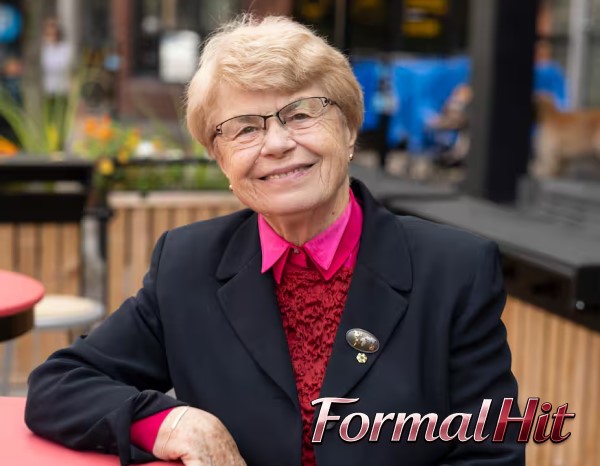
Soeur Angele holds a rare place in Quebec culture: part religious sister, part television personality, and part culinary institution. For nearly seven decades, Soeur Angele has combined faith, food, and public life in a way almost nobody else in Canadian broadcasting history has managed.
This article walks through her full story, covering Soeur Angele’s age, her Italian origin, her family background, and the honest answer to a question a lot of people ask: does Soeur Angele have children? Here’s everything worth knowing, gathered in one place.
Who Is Soeur Angele?
Soeur Angele was born Angiola Rizzardo, later nicknamed Ginetta, then Gina, before settling into the name most Quebecers know her by today. She’s a Catholic religious sister who became one of the province’s most recognizable television cooking personalities, teaching French-speaking Quebec how to combine everyday Canadian ingredients with the flavours of her native Italy.
Her path from a small mountain village in Italy to national Canadian television is genuinely unusual. Soeur Angele didn’t set out to become a media figure; her fame arrived almost by accident, after a talent for cooking and a natural warmth in front of cameras turned her into a household name.
Soeur Angele Age: A Life Spanning Nearly Nine Decades
People searching for Soeur Angele’s age are often surprised by just how long her public career has run. She was born on August 11, 1938, in Cavaso del Tomba, near Treviso in Italy’s Veneto region, which puts her at 87 years old as of 2026.
Her timeline reflects a life shaped early by hardship and later defined by reinvention:
| Age | Milestone |
|---|---|
| Childhood | Grows up during the Second World War in rural Italy |
| 12 | Learns basic cooking skills at a local café near her home |
| 17 | Emigrates alone to Quebec in 1955 |
| 19 | Joins the Notre-Dame-du-Bon-Conseil religious congregation |
| 33 | Earns a teaching diploma in food and culinary arts, 1971 |
| Later years | Teaches 16 years at Quebec’s Institut de tourisme et d’hôtellerie |
| 69 | Receives a papal audience with Pope Benedict XVI in 2007 |
| 87 | Publishes her memoirs and a Radio-Canada documentary, late 2025 |
That progression shows Soeur Angele’s age isn’t just a number; it represents nearly 70 years of continuous public life in Quebec, spanning teaching, television, publishing, and religious service.
Soeur Angele Origin: From Wartime Italy to Quebec
Understanding Soeur Angele’s origin means understanding the world she grew up in. She was born into a large farming family in the mountains of Veneto, at the very start of the Second World War. Her childhood included real hardship, including the direct experience of wartime violence and social injustice in rural Italy.
At just 17, she made the decision to leave home and cross the Atlantic alone, arriving in Quebec in 1955. That’s a striking detail people often miss: Soeur Angele’s origin story isn’t one of gradual immigration with family support, but a solo journey undertaken by a teenager rebuilding her life in a new country and a new language.
She learned French at Montreal’s Hôtel-Dieu hospital after arriving, and two years after landing in Quebec, she entered the Notre-Dame-du-Bon-Conseil religious congregation. That’s the moment Angiola Rizzardo formally became known as Soeur Angele, a name that would eventually become recognizable across the entire province.
Soeur Angele Family: Her Roots and Personal Life
Soeur Angele’s family background is rooted firmly in rural Italian tradition. She came from a large family of mountain farmers, a detail that shaped her lifelong values around generosity, hard work, and feeding people well, themes she carried directly into her culinary teaching career.
Her devotion to the Madonna del Covolo, a Marian shrine connected to her hometown, remained a significant part of her identity even after she’d spent decades in Canada. That connection to her Soeur Angele family roots in Italy never really faded, even as she became one of the most Quebecois public figures on television.
It’s also worth noting that Soeur Angele has spoken about her family history in her own words. In 2013, a biography written by Concetta Voltolina told her story, originally published in Italian and later translated for Quebec audiences. More recently, in late 2025, she released her own memoirs, giving readers a firsthand account of her family background, her spiritual path, and her media career.
Does Soeur Angele Have Children?
This is one of the more commonly searched questions, and it deserves a clear answer. As a Catholic religious sister who took vows, Soeur Angele does not have biological children of her own. Her life’s structure, as a member of a religious congregation, doesn’t include marriage or biological parenthood.
That said, the question of Soeur Angele’s children often comes up because of how maternal her public persona feels. Generations of Quebecers grew up watching her on television, and many describe her influence in almost familial terms, as someone who taught entire households how to cook with warmth rather than formality. In that cultural sense, her legacy functions like an extended family, even without children in the traditional sense.
Career Highlights: From Convent Kitchens to National Television
Soeur Angele’s rise to fame wasn’t planned. She was originally responsible for cooking meals for 200 people at her religious community’s residence, working with tight budgets and learning to stretch ingredients creatively. That practical, resourceful cooking style later became the foundation of her public television persona.
In 1967, following changes introduced by the Second Vatican Council, she began wearing civilian clothing instead of a traditional habit, which allowed her more flexibility to pursue formal culinary training. She completed professional courses in cooking, baking, and pastry at Quebec’s Institut de tourisme et d’hôtellerie between 1975 and 1980, on top of the teaching diploma she’d already earned in 1971.
Her television career happened almost spontaneously after a culinary demonstration drew a massive public response. Broadcaster Jacques Boulanger was reportedly so impressed that he pushed to give her a recurring spot on his program, launching what became decades of television appearances. Some of her key accomplishments include:
- Receiving the title of official ambassador for Canada’s Ministry of Agriculture
- Being awarded the Governor General’s Award
- Meeting Pope Benedict XVI in 2007 to mark 50 years of religious life
- Having a specialty cheese named after her in 2008, with proceeds supporting charity
- Publishing multiple cookbooks and, later, her own memoirs
Why Soeur Angele Still Matters Today
Even in her late eighties, Soeur Angele remains active, giving talks, making public appearances, and continuing to represent Quebec’s culinary culture. Her story resonates because it blends immigration, faith, and food into something genuinely unique in Canadian media history.
Few public figures manage to represent both religious devotion and mainstream entertainment credibility at the same time, yet Soeur Angele did exactly that for nearly 70 years. Her origin as a teenage immigrant from wartime Italy, combined with her family’s farming background, explains a lot about the values she brought to Quebec kitchens and television screens alike.
Frequently Asked Questions
How old is Soeur Angele? She was born August 11, 1938, making her 87 years old as of 2026.
Where is Soeur Angele from? She was born in Cavaso del Tomba, near Treviso, in Italy’s Veneto region.
Does Soeur Angele have children? No, as a Catholic religious sister, she does not have biological children.
What is Soeur Angele known for? She’s known for combining Italian and Quebec cooking traditions on Canadian television while remaining a member of a Catholic religious congregation.
Final Thoughts
Soeur Angele’s story stands apart from almost any other figure in Quebec media, blending a wartime Italian childhood, a solo teenage immigration, decades of religious life, and an unlikely rise to television stardom. Her origin, her family roots, and her age all point to the same conclusion: this is someone whose influence on Quebec’s culinary culture runs far deeper than a typical celebrity profile. For anyone interested in how faith, food, and resilience can intersect over a lifetime, Soeur Angele’s journey remains one of the most genuinely remarkable stories Quebec has to offer.


