

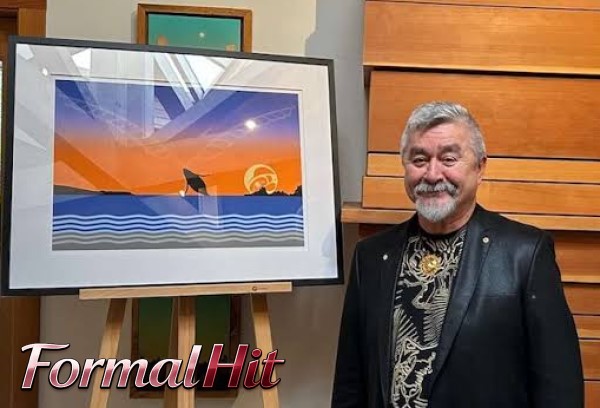
Few Canadian artists have shaped how the world sees West Coast First Nations art quite like Roy Henry Vickers. His bold prints hang in museums, airports, and living rooms across the country, and his life story, one of resilience, culture, and reinvention, is just as compelling as the art itself. This article covers everything worth knowing about Roy Henry Vickers, from his early years on the Nass River to where he stands today.
Who Is Roy Henry Vickers?
Roy Henry Vickers is a Canadian First Nations artist, author, and speaker known for his distinctive limited-edition prints that blend Indigenous imagery with bold, contemporary colour. Born in June 1946 in Laxgalts’ap (formerly Greenville), British Columbia, he is a Grammy Award-nominated artist who owns and operates a gallery in Tofino, British Columbia. Over five decades, Roy Henry Vickers has built a body of work that includes silkscreen prints, paintings, carvings, and totem poles, earning him recognition as one of the country’s most celebrated living artists.
He holds both the Order of Canada and the Order of British Columbia, and his art has been presented as an official government gift to heads of state, including Queen Elizabeth II. That combination of artistic skill and cultural significance is why Roy Henry Vickers remains a household name in Canadian art circles.
Early Life and Roy Henry Vickers Family Background
Roy Henry Vickers’ father was a fisherman of Haida, Heiltsuk, and Tsimshian ancestry, while his mother was a teacher of mixed European heritage. His mother, Grace Freeman, came from Yorkshire stock, and his father, Arthur Vickers, was half-Tsimshian and half-Heiltsuk. This mixed heritage became a defining thread throughout his artistic career, shaping the symbols, colours, and stories found in his work.
The Vickers family lived in Kitkatla, Hazelton, and Victoria as Roy grew up, giving him a childhood rooted in different corners of coastal British Columbia. His grandfather, a skilled canoe carver, introduced him to the spiritual symbols that would later define his artistic style. Roy Henry Vickers family history is also tied to the arts more broadly, his brother, Arthur Vickers, is a well-known carpenter and artist in his own right, and even designed Roy’s Tofino gallery.
Vickers graduated from Oak Bay High School in 1965 and worked briefly as a fireman in Victoria before shifting toward a full-time artistic path. In the early 1970s, he enrolled at the Gitanmaax School of Northwest Coast Indian Art in Hazelton, BC, where he formally trained in traditional Northwest Coast carving and design techniques.
Roy Henry Vickers Art: Style and Signature Work
What sets Roy Henry Vickers art apart is its fusion of traditional Indigenous storytelling with a clean, modern visual language. His silkscreen prints typically use bold, primary colours and imagery drawn from nature, eagles, salmon, orcas, and coastal landscapes appear again and again throughout his catalogue. This style has made his work instantly recognizable, even to people unfamiliar with Northwest Coast art traditions.
Some of the most notable pieces and moments in his artistic career include:
- A Meeting of Chiefs — presented as the official gift from the Province of British Columbia to Queen Elizabeth II at the 1987 Commonwealth Summit in Vancouver.
- The Homecoming — given as artist’s proofs to Boris Yeltsin and Bill Clinton during their 1993 Vancouver Summit.
- The Salmon Totem Pole — a 10-metre carved pole created for the 1994 Commonwealth Games aquatic centre near Victoria, BC.
- Vancouver International Airport commissions — Vickers served as artistic advisor for the airport’s new terminal from 1987 to 1995, and his work remains on display there today.
- A 2018 Grammy nomination for designing the presentation box art for the Grateful Dead’s Pacific Northwest ’73–’74 box set, a project that took three years to complete.
Roy Henry Vickers has also written and illustrated several books, including Solstice: The Art of Roy Henry Vickers (1988) and Copperman: The Art of Roy Henry Vickers (2003), along with children’s books co-created with author Lucky Budd. His work is held in major public collections, including the Canadian Museum of History, UBC’s Museum of Anthropology, and the National Museum of Ethnology in Osaka, Japan.
Roy Henry Vickers Wife and Personal Life
Roy Henry Vickers’ personal life has had its share of change over the decades. He was previously married to Liane Leslie Vickers; that marriage ended in 1978. He later found lasting partnership with his current wife, Andrea, whom he married in 2001. Together, the couple has raised two children, a son and a daughter.
Vickers has also spoken candidly about a difficult chapter in his life: his struggle with alcohol addiction, which he battled from the late 1960s until 1992. That year marked a turning point, as he checked himself into a recovery clinic in Arizona and committed to sobriety. He later founded VisionQuest, a non-profit organization dedicated to helping others facing addictive personalities, and has since become an outspoken advocate for recovery within Indigenous communities.
Where Is Roy Henry Vickers Now?
So, what is Roy Henry Vickers doing now? He continues to run his flagship Eagle Aerie Gallery in Tofino, British Columbia, opened in 1986 in a building inspired by traditional longhouse architecture. The gallery remains a popular stop for art lovers visiting Vancouver Island, showcasing his prints, paintings, and carvings alongside work from other Indigenous artists.
Roy Henry Vickers now spends much of his time as a public speaker, sharing lessons on resilience, addiction recovery, and cultural identity at events across Canada. He remains active in publishing too, releasing books and collaborating on new projects. Now in his late seventies, Vickers is widely regarded as an elder statesman of Canadian Indigenous art.
Roy Henry Vickers Net Worth
Because Roy Henry Vickers operates as a private individual and business owner rather than a publicly traded figure, there’s no officially verified or audited figure for his net worth. What’s clear from public sources is that his prints have sold for tens of thousands of dollars individually, some pieces have carried price tags of more than $30,000, and his decades-long career running a successful gallery, publishing bestselling books, and completing prestigious commissions points to considerable financial success. Readers should treat any specific net worth figure circulating online with caution, since these estimates are rarely sourced from verified financial records.
Recognition and Honours
Roy Henry Vickers’ contributions to Canadian art and culture have earned him significant formal recognition over the years:
| Year | Honour |
|---|---|
| 1994 | First artist featured in Maclean’s Annual Honour Roll of Extraordinary Canadian Achievers |
| 1998 | Appointed to the Order of British Columbia |
| 2003 | Received the Queen’s Golden Jubilee Medal |
| 2006 | Made a Member of the Order of Canada |
| 2018 | Grammy nomination for Grateful Dead box set design |
He has also received several hereditary names and a hereditary chieftainship from Northwest Coast First Nations.
Frequently Asked Questions
What is Roy Henry Vickers best known for? He’s best known for his limited-edition silkscreen prints that combine Indigenous West Coast symbolism with bold, contemporary colour, as well as his carvings, totem poles, and books.
Where is the Roy Henry Vickers gallery located? His flagship gallery, the Eagle Aerie Gallery, is located in Tofino, British Columbia, and has operated there since 1986.
Is Roy Henry Vickers still creating art? Yes. Roy Henry Vickers remains active as an artist, author, and public speaker, continuing to run his Tofino gallery and take part in cultural and community initiatives.
Did Roy Henry Vickers struggle with addiction? Yes, he has openly discussed his recovery from alcohol addiction, which he overcame in 1992, and he later founded VisionQuest to support others facing similar struggles.
What awards has Roy Henry Vickers received? He has received the Order of British Columbia, the Order of Canada, the Queen’s Golden Jubilee Medal, and a Grammy nomination, among other honours.
Final Thoughts
Roy Henry Vickers’ story is one of cultural pride, personal transformation, and lasting artistic achievement. From his early years learning traditional carving techniques from his grandfather to becoming a Grammy-nominated, Order of Canada-recognized artist, Roy Henry Vickers has built a legacy that bridges Indigenous tradition with contemporary Canadian identity. His art, his advocacy for addiction recovery, and his role as a mentor to younger artists all point to a career defined by growth and generosity.
If you want to experience his work firsthand, visit the Eagle Aerie Gallery in Tofino or explore his published books, both offer a genuine window into one of Canada’s most important living artists.
